Interview with Kate Daudy by James Fox
2024
Interviews
JF: We met in the Pilates class of our friend Idris Moudi – along the corridor from your studio in Westway, West London, but I only slowly became aware of your work and your unique blend of art and activism. You told me later that you like to hide behind collaborations - that ‘it’s a good way not to be noticed in the background.’ But that didn’t work: Already you had constructed your refugee tent, the installation you called ‘Am I my Brother’s Keeper?’ that went on display in St. Paul’s cathedral and around the world and propelled you to international fame. And now the Sorbonne, in Paris, have offered you a term of teaching, and this exhibition of your work, which is a great accolade. You wanted to have this interview instead of a catalogue blurb, you said. I asked you if it should be tilted to those who already know your work and you replied, still apparently occupying the background, ‘Nobody knows about my work’.
KD: Yes, the Sorbonne offered me a catalogue. It literally just occurred to me while we were doing our Pilates class to do an interview with you because I was about to talk to the curator. I thought it would be really fun to do it with you as a conversation rather than getting some art historian to say, Kate did this, Kate did that. I’m not really trying to be that kind of person. Or at least I can do it another way.
JF: How did the Sorbonne show come about?
KD: I’d known Yann Toma, the curator, [Professor of Visual Arts at Sorbonne University where he directs the Art & Flux research team] for quite a long time and he asked me. And I said, definitely, because I thought [a show at the Sorbonne] would be quite cool. And I want to do things in France because I speak French. I like France and I never do anything in France, which is silly because I’ve now started to think that my work could be like a good travel agency. If we are saying that my work is a little bird, just hatched and learning a little bit how to fly, I can fly a little bit further from the nest than I thought. So, I could decide that I’d like to do more stuff in France, which is easy for me to do next year, for example, because I’m going to live for the whole of next year in France anyway.
JF: I’ll ask about that later because you have a fascinating project in store there. But for now, let’s plunge in where you plunged in. Into the biggest story of our time – of people displaced by climate, famine, persecution, war: of refugees. Can you tell me what your tent had to do with this and how it came about?
KD: My initial idea was much more abstract; to make a work about home and identity using a tent, initially to explore it through the prism of the story of Philemon and Baucis – the myth of the Phrygian couple who took in Zeus and Hermes, disguised as poor travellers, who’d been turned away by their rich neighbours. I wanted to convey a message of hope and shared humanity, using art and storytelling to try and make people think differently and think in a way that could be constructive.
JF: You were on a quest, therefore, to dig into man’s inhumanity to man?
KD: I suppose what I’m inviting myself and other people to think about is, why have people forgotten that they have agency? And that the decisions that each of us make about anything are really important and have huge consequences. I feel at the moment there’s an awful lot of things going on in the world that we can do something about. If ‘art’ of all forms is some sort of an active agent in society, then an artist has a role to play in inviting people to think about these big questions and making them feel empowered. Because I believe if people had more confidence in themselves, they would be more involved with one another. Perhaps we’d make better decisions about communicating. Perhaps we’d be more fervent about what we believe in. I’m not saying that’s necessarily a good thing or a bad thing, but I meet so many people who say, ‘Oh, what I really want to do is a PhD in biology.’ If people did what they would like to do, then I think the world would be a more harmonious place.
JF: The tent and its contents show what an enormous amount of research you did, travelling, asking questions, listening to peoples’ stories.
KD: Once the idea of using a used refugee tent occurred to me of course the whole nature of the project changed. I’m still completely devoted to the UNHCR, despite lots of people saying they don’t like them and they’re difficult to work for and all the rest of it. I was given this tent and Daniel Endres, a humanitarian co-ordinator at the UNHCR, set up a programme for me to go around and meet refugees and ask them all my questions. The UNHCR gave me translators and they set up interviews for me in different refugee camps in the Middle East. During the course of this project, I met a couple of hundred people: including diplomats and doctors and people involved as volunteers, people who’d become refugees. Even here in the UK I spent some time at the Holocaust Survivors Centre, which is this extraordinary place in Hendon. I had Hanukah with these people called the Boys. Because after the Second World War, as you surely know, the British government didn’t behave very well at all, they were very unfriendly. They offered to take under-eighteens from the refugee camps, but only if they were paid for. They also had to pay for their passage, something like £2,000 pounds at the time, which is like £50,000 or £60,000 pounds now. So, the British Jews and the Quakers joined together and paid for the passage of 97 children who’d come over from the camps. Some of them were three years old. But there were only 97 from all of those concentration camps. They became this group of people who were extremely bonded to this day. I had tea with them in Hendon seven or eight years ago and they told me their stories. So anyway, during the course of all of this and going to centres for rehabilitation, for torture victims and so on – and I’m this middle-class girl from West London – I just didn’t really know where to put all of this information. So I made this tent out of it.
JF: Well, the tent is of course a powerful symbol because what’s going to happen to these streams of people coming out of the deserts and so on? Are there going to be tent cities? Has anyone thought about what they’re going to do with these vast numbers of people?
KD: Well, they are thinking about it. They don’t like tents anymore, tents have to be replaced all the time because they rot or catch fire. My tent had been lived in for a year and a half by a man called Abu Taim. He’d written his name on it.
JF: Where was he living?
KD: In Jordan. They wanted to give me a new tent but I said a new tent’s not interesting. I want a tent that somebody’s actually lived in. So they gave me the discarded tent that had belonged to Abu Taim. When it arrived it was huge, and all these pebbles and fag ends and food wrappers and the back of an earring fell out on the floor of my studio. It was so incredible. And also it had a language. The different agencies have a language they write on tents, because when you arrive, you’re registered with all these different programmes. By the way, as a refugee you’re already doing quite well in those situations because there are a lot of people who can’t get refugee status because they’ve not been registered at birth – they live on some hilltop and nobody bothered to register their birth, so they’ve got no papers. I met a lady who couldn’t get refugee status for herself or her child because she had no record of her husband’s existence, apart from that she had had two children with him. But he didn’t exist because nobody had ever registered his birth. They managed to find proof of his existence because he had visited her in hospital when the second child was born and then clearly he’d been killed or he’d vanished. But there was a record of him having visited her in the hospital and she had a child. Therefore, that child must have had a father because he had shown up to visit the woman at the hospital, so the child could get refugee status, which it hadn’t been able to have before. It’s bureaucracy. I met this lady who had three plastic carrier bags full of all her papers because somebody had told her, before you leave as a refugee, the only thing that matters is your paperwork because you can prove that you existed. So she travelled around all these different countries with huge carrier bags full of papers. And she was really proud of them too. I sat in her flat and she showed me all these papers.
JF: It’s astonishing. There is this huge world moving about, clutching papers, dispossessed; it’s a big chunk of the world on the move.
KD: 114 million registered refugees at the moment.
JF: That’s incredible.
KD: At the beginning of my tent project, I wrote on the tent the number of refugees, 64 million, and now there’s 114 million.
JF: And that’s going to double in 10 years. What else was written on the tent, or inside it?
KD: Outside the tent were facts and quotes from refugees and people involved in the refugee crisis. Facts like: ‘The average stay in a refugee camp is 19 years (now gone up to 24 years),
84 % of refugees are women and children.’ The conditions for being accepted as a refugee were all around the black base of the tent. There were quotes that I had collected from conversations, like:
“I was like someone losing my mind.
I sat there among all the corpses.
‘Let her die of sorrow’ they said. And they left me.”
We had hollyhocks and a tree composed out of crochet circles that I commissioned from “internally displaced” women in Syria. On the whole, the idea was to curate something beautiful and compelling to look at out of the words and handmade artworks made by refugees themselves. The further idea being that if we are all one, then we can perhaps learn from one another’s experience.
JF: What’s interesting is that you go to the people who are suffering from this disharmony – the most powerless, who are being thrown or pushed out of places by famine or cruelty or politics and who have had reason to despair of human nature – and ask them for clues of how we could live together in harmony.
KD: Yes. And not a single one – not a single one – said ‘it’s that guy’s fault’ or ‘give me a fiver’ or anything. They only had these extraordinary messages of sweetness and people telling me how lucky they were. That’s what put me into this state of really wanting to do something useful with my work. Because I’d never met people who seemed more full of grace and dignity and courage than these people, who would quite seriously explain to you that they were very lucky because they still had a child who had survived, or it was such a nice day, or because it was a pleasure to have me over for tea and give me the tiny supply of whatever they had for tea. And then I’d come back here and pick my kids up from school and there’d be the beautiful blonde in her Bentley saying that she was pissed off her kitchen hadn’t been painted in the right colour or something. And the disconnect made me feel upset with myself because I felt that I was judging myself and others by this impossibly high standard of people who I had come across.
JF: Instead of judgement though, you plunge in, unlike most people. You are an activist. You put actions to words, it seems, when you see an opportunity. And your tent has travelled with you as your very popular partner?
KD: I have done activist art. In Palermo for Manifesta, I organised a huge procession on the theme of welcoming refugees to Italy and it took over the centre of town for two-thirds of a day. I made banners for people and I got all these bands to come and play. And we did a collaboration with the UNHCR, so loads of refugees joined in. It was really weird timing because the day that the procession took place was also the day that the governor of Sicily refused to take in a boat with 350 refugees and the UNCHR had to negotiate for them to be taken in somewhere else because they had nothing to eat, and three of them had died. Do you remember all of this?
JF: I remember it well.
KD: So the guy who ran the UNHCR in Europe was the guy who was launching this day for me, or rather, I was doing the day for him. And there was so much noise and fuss in every direction that the only quiet place he could find was inside my tent. So he went inside my tent and negotiated with the Spanish government to get them to take the boat in, which was really cool. My art was actually useful. And then we had this procession, and everyone enjoyed it, and it was on the news – that was proper activism.
JF: What an honour for you and your tent. Where is the tent now?
KD: It got lost. It was going around the whole of Spain, visiting every city, and it was a huge thing, this tent. It had already been invited to the UN headquarters in New York and to the Metropolitan Museum in New York. It was like the most beautiful girl at the party. It had a card, if you see what I mean. And then somebody at the EU wanted to put it right in front of the entrance of the EU so that people would have to step around it to get in to talk about whatever it was, the budget that they were going to give to the refugees. So I rang the guy who had it and he said, ‘Oh, we can’t find it.’ The tent was quite big. It weighed like 68 kilos and it had these tent poles – so he had kept it outside of his office on the stairs and while it was waiting to be put up in the next place, somebody asked him to move this tent because it’s was in the way, and he didn’t do so. They asked again and he didn’t. And then on the third time, she came with a couple of guys and put it in the skip. Which is an interesting analogy for the whole situation anyway, because that’s just a tent but imagine if that’s a human being’s life. And so it strikes me that one day when I’ve got a bit of time and energy, I should get a bunch of people together to write about the absence of things, which seems to be an interesting point to make.
JF: Since then, you’ve collaborated with a lot of interesting people. Tell me about your collaborators.
KD: Well, the one I’ve collaborated the longest with, is Kostya Novoselov. Kostya is a Russian physicist, currently working on creating Functional Intelligent Materials at the NUS. [National University of Singapore]. I have been working with him for about 7 years on an art plus science project entitled ‘Everything is Connected’.
JF: He gives the impression of being a very brainy character.
KD: He is, yeah. Kostya and his friend André Geim discovered something called graphene.
People thought graphene existed but were not sure, until Kostya and André discovered it.
He has now invented a functional intelligent material that can heal itself, be programmed.
Kostya is a genius. He got a Nobel Prize when he was 34.
JF: A thinker in the spheres?
KD: It’s really exciting because he’s actually a genius, and he can also fix your washing machine. He’s not a genius who you have to help across the street. He’s a fully functioning nice guy who’s just in another realm. It’s very fun doing a collaboration with somebody like that because you put a question in and there’s a silence, and then he comes out with something really interesting. Every time. I love people and I especially love kind people. But then also in that mix, I really like interesting people. I try and hang around when I can with interesting people.
JF: But how did you first join up with him?
KD: I was having an existential crisis, a proper one, after I did this refugee project. I couldn’t sleep for about four years, not properly. I was just always thinking, is there anything that’s true? What can we count on? If our life is what our thoughts make it, what are the facts? There must be some facts. It can’t just be subjective, all of this. There must be some true purpose. So I started going around talking to all these theologians. I went to the CERN in Geneva and spent some time with the theoretical physicists there – because the advantage of having an existential crisis and being an artist is that you can write a letter to all these really interesting people and they’ll say, oh yes, we’d love to talk to you. So I asked all these really interesting people, what’s it all for? What’s it about and what about you? And then somebody said, you should meet my friend Kostya, because he’s always asking himself this kind of question and he loves art. So I met Kostya and we just hit it off. I was doing a project then in Manchester about all of this and I said, do you want to do it with me? When we met each other, I wasn’t at all interested in questions of, how did you discover these cool things and what’s it like being so brainy? I was like, so, tell me about carbon, and maybe that means that we are all one. (Actually, we are all just different arrangements of carbon.) And is it really true that if you add two and two, you get four? Or can it sometimes be 4.2? And of course, Kostya was a very disappointing interlocutor because he was like, ‘Yeah, there is no end to the questions.’ When you are a physicist at that level, every question is met with another question. He’s thinking about things in a way that I recognise. I’m really interested in language and thinking. Of course, I’m not saying I’m as brainy as Kostya, but I see what he’s doing. He invents something that doesn’t exist and he has to invent a whole new language to convey the idea of that to another person who’s never even thought about that effectively, so that he can then drop it and do something else. That’s what he does. He kind of sets things up. He asks questions, finds out the answer, and then puts the answer on the table, not even wrapped in a bow, and then he moves on to the next thing. So he’s constantly doing all these papers. I don’t mean to say that he doesn’t care what happens with his findings, but he’s more interested in the questions. So he said to me, there isn’t an end to any of these questions and there is no absolute truth. And if you look at ‘two and two is four’ from a variety of different angles, it’s an irrelevant question and you can’t count on the answer. So therefore, he was the perfect person to do all these collaborations with, because we could just sit and ask each other questions all day and then do projects inviting people to consider the fact that, at the end of the day, the only one truth you can count on at all is that everything is one, that everything is connected. So maybe I see that from the point of view of spirit, but he sees that it’s just a different arrangement.
JF: You did two astonishing, and ambitious collaborations with Kostya involving driving a large herd of sheep across the plain of Castile, as part of the Hay Festival in 2022 in Segovia.
KD: There was one about random numbers, and one about living in harmony with people who you don’t agree with. That’s the one in Spain, the one to illustrate Einstein’s Unification Theory, which is that if you get two opposites and force them to mix, they will mix. More or less. We wrote on 470 sheep, ‘YES’ or ‘NO’ and walked them across the plains of Castile to Segovia, and then they ran around in a circle in an area beneath the Roman aqueduct there, proving to us the possibility – as they formed random groups – of individuals living peacefully together.
JF: How far did they walk?
KD: In this instance, it was a day.
JF: Were you on the walk?
KD: Yeah. I painted all the sheep the day before and then we walked them the following day.
JF: It must have been very satisfying.
KD: It was very satisfying.
JF: The pictures of it look very beautiful, a moving art installation.
KD: Yeah, it was a beautiful experience. The shepherds were very interesting and wise. The main shepherd, Raphael, was a wise man, and it was such a great honour to spend two or three days with him walking with his sheep. But the guy who worked with him really had it in for Kostya, because Kostya was trying to help. I was just walking along – I never think I can help someone who knows what they’re doing. But Kostya was very much trying to help. He’d see that somebody was pushing the sheep in this direction and he’d try and help. And of course the sheep didn’t appreciate that and they got confused. So the shepherd’s assistant said, ‘I’ve had it up to my balls with this guy’, meaning Kostya, who’s there smiling and being friendly.
JF: It wasn’t all humanity and harmony.
KD: No, not at all. That was really funny. So me and Kostya have this mission to say, if we are all one, and if everything is connected, then it’s an idea to try to live more harmoniously together.
JF: You made, among many other projects, a beautiful exhibition in Grenada, with 38 sculpted stones to commemorate the short life of the poet Fredrico Garcia Lorca – whose murder by the fascists under Franco has divided Spain politically ever since. I know he’s a major inspiration for you, and a symbol for lasting disharmony. So what are the origins of this concern, this sadness about the disharmony in the world? Where did this spirit come from? Have you always had it, in some form?
KD: Yeah, I think I always have.
JF: I mean, I know children like that.
KD: There you are. I feel really lucky that I’m still fretting about these things because it’s nice, actually. It makes me alive. There’s always something that we can do, and I want to be useful.
JF: Well, you have an enormous amount of energy. I mean, you’ve got to be very persistent. You’ve got to do a lot of work to attract the attention of so many people. Do you drive yourself or is the momentum there?
KD: I think I like working. I really enjoy my work. You meet someone really interesting and something interesting can happen out of that. If you interact with other people, then there’s always going to be some positive energy that’s worth engendering.
JF: What are you going to put in your space in the Sorbonne?
KD: They want nine photographs that illustrate the driving force of my work, a sort of survey of my work, because they think I am a visual thinker. What’s interesting about having this survey at the Sorbonne for me is, firstly, I’m quite insecure so it’s nice to have a swanky university saying that I’m clever. And secondly, I get to meet some young people. I really like having conversations with young people because I do have this kind of mission to invite people to think about these things. I feel like I can be a useful conduit in society through my work – not as a person, but if I can put questions and invitations to think about things in lots of different places, then I’m doing what I can. Like the Hopi snake dance, I’m putting out energy that might come to something, and if I can, then I should. Other people do other things. I’ve got this knack for making visual work of a certain sort.
JF: The big question to ask any artist whose work you like is what are you trying to do and how are you doing it? They’re quite simple, but they’re quite difficult questions to answer.
KD: Very difficult questions to answer. So I’m trying to make the world a more pleasurable and harmonious place by inviting people to think about things – because I don’t think I can do that, but I think people can do that for themselves if they think about things. So for example, this project that I’m supposed to do in Paris next year came out of an invitation to be a part of this three-pronged project in the cloud forest in Bolivia. This woman, Dr. Niki Barbery Bleyleben has been given 400,000 hectares of cloud forest, which is above the clouds. It’s an amazing part of the world in Bolivia. One part of this project is her and wildlife conservation – the panthers or cheetahs or whatever that can be saved by being able to run along these corridors in the middle of this forest. There’s a second part, which is a social-change-through-agriculture project, with a chef from Denmark called Claus Meyer, who has a restaurant in La Paz called Gustu. People queue around the world to eat there and it’s booked up three years in advance. Meyer believes in social change through agriculture, so he’s been going around interviewing people and digging up plants and seeds and planting them in this cloud forest in places where they used to grow. People stopped bothering with these recondite crops because they can have wheat and beef and all these foodstuffs that have been imported from the west. He’s got the most stars in the world as a chef and the first part of his project involves beehives. I’m going to go over there in November and build beautiful beehives with the tribespeople there in these kind of biomorphic shapes. Which is what led me to make these honey-stained glass windows that I’ve been making recently.
JF: The ones that fill up with honey?
KD: Yes. They were commissioned by Columbia University [Institute for Ideas and Imagination] as an experimental art installation: the Honey Window, it’s called. The honey is sealed between two perfectly sealed pieces of glass, and it crystallises and melts according to the temperature. Then the idea is that the sun shines through it and you get this amazing golden shadow. It’s a really interesting way of looking at time because you can measure it through the state of the honey in these glass frames. It’s really beautiful: one of the windows has started to crystallise and cloud over, and they’ve been taking photographs of the institute using these honey windows as a lens. That’s another offshoot of that project. So we’ve got the wildlife, we’ve got the social change through agriculture, and Meyer has got this restaurant. And then in the third part of this same project, I’m going to build these beehives and do temporary ephemeral structures that are going to be built out of the forest floor in which he can serve his incredible meals. I’ll be constructing them with my friend Pilipino, who has invented the biggest 3D printer in the world. We’re going to 3D print out the forest floor mud, to make these spaces that will get washed away, and then build more ...
JF: Do you get to interact with the bees?
KD: Oh yes. They’ve given me this fellowship at Columbia University to study the way that we communicate with one another, and looking at man’s relationship with nature. I’ll be working on “Telling the Bees,” a project looking into the symbiotic relationship between the bee and us and how we might learn from ancient beekeeping traditions in order to build a more harmonious world. In ancient tradition, beekeepers would always talk to their bees. Through all cultures, if you were a good beekeeper, you would talk to your bees. I found out about it when the Queen died and the Queen’s beekeeper was on TV announcing the death of the Queen to the bees. He wrapped the hives in a big black ribbon and read a sort of formal statement to the bees saying, ‘The Queen is dead, but now the King is going to look after you and he’s a good man’ and so on. A good beekeeper introduces his children, his newborn baby to the bees. When his daughter gets married, he takes the daughter and the husband to meet the bees and they give flowers to the bees and introduce themselves. So I was thinking what we could learn about that for ourselves and the way we communicate with nature and with other people? This gentleness and this apparent pointlessness, I think that’s one of the big truths that I’m beginning to see as important – the little pointless things that you do, like telling the bees, like going to the trouble of wrapping the beehives in beautiful black velvet bows – has got to be one of the things that’s probably quite important.
JF: Well, I think to be a bee whisperer is to be envied, because bees are the most intelligent creatures on the planet. They’re very, very clever. It’s beyond belief what bees can do in terms of mental agility.
KD: In this vein of gentleness, maybe pointlessness – but I don’t think so – I was talking to my son the other day about my friend’s dad. He looks like he’s quite a busy, formal, posh English guy. And he took a shining to Theodore, my son, when he was little, and he used to come round in his beautiful suit and feed my child. He’d tell me off about things he thought needed attending to and I’d be like, ‘oh Theodore’s fine, don’t worry’. Poor Theodore, he was little and he was the youngest child. I used to take all his clothes off and just feed him, most ungraciously probably. But anyway, this old man would come in his suit and bring a little gift, a little bunch of flowers. It was almost Japanese. And then he’d sit with Theodore – he didn’t want to talk to anyone else – and he’d feed him beautifully with just the right amount of food on his spoon and talk to him and tell him stories. He just loved Theodore.
JF: Well, I think the Buddhist attitude of being one with the universe, not a superior being at all, but to live in harmony with all the creatures, is an essential sort of activism about how to treat each other, how to treat the world, how not to spoil it and so on. It’s vital. I think this goes with the way you incorporate ancient wisdom into your works through texts and calligraphy, in a way the Chinese have always done. It’s clever, and it looks beautiful. You’ve done a lot of research into Chinese, Egyptian, Aramaic.
KD: I studied Chinese at university and then just now during the lockdown, I was learning Aramaic and reading all these ancient texts, which have been so badly translated. For example, there’s no concept of sin. Nobody talks about sin. It’s a mistranslation. The actual term is to ‘temporarily stray from your path.’ Imagine, 2,000 years of people feeling bad about themselves and it’s just, well, you temporarily strayed from your path.
JF: Are you looking through these texts for lessons, forgotten ideas of how to conduct ourselves and relate to other people? Are these lost insights? Are the solutions buried in these texts? Or do they have some other magical or spiritual function? You sometimes use them like the artist David Jones as a sort of abstract form – for their evident power even without translation.
KD: These are literally the questions I ask myself. The Chinese tradition I like, the tradition that my work comes from is the work of writing on things, which comes from ancient China and comes from discovering yourself through the world around you as an art form. The ancient Chinese had a different idea of the self. If you were just a normal guy in ancient China, you didn’t even really have a fixed name until you were seven. And then you chose a name for yourself when you were a student – a student name – but you wouldn’t really have a fixed identity for anybody. Your wife would call you one thing, Idris would call you another thing, I would call you Idris’s friend. When you read an ancient Chinese novel up until the 19th century, it’s very difficult to follow the characters because they’re all referring to one another with different names. There’s actually keys at the back in the new translations, saying this person is the same character as the one from chapter 12, but they’re calling her a different name because she’s in a different social context. Some aspects of your identity would be fixed – you are a greengrocer and you live in Hangzhou, and even at one point in ancient China, they had a state uniform. So if you are a greengrocer from Hangzhou, and you’ve got two wives and your daughter just got engaged, then you wear – I’m making this up – a green robe, blue buttons, your hair’s done in a certain way to show that your daughter’s engaged. So I could look at you, I know the code, and I know who you are. I know the external points about your existence that might be useful for reference. And so that would be your identity. Your identity is to be a part of your family unit. Your trades, then your town, then your province. But you yourself, if somebody says, do you like eggs? Or how do you feel about your family deity? It’s not a question that you’ve thought about very much. You’d be like, I don’t know, it’s just my family deity. People weren’t educated to think about themselves in that way, apart from this very small scholarly class who were chosen to take these civil service examinations. They would be shipped out to the court and sent to these schools for seven or eight years, all these little boys, and educated to the highest degree and given an idea of themselves. And then once they’d passed the exams, and they’re all really good friends and all educated in this particular way and with a burgeoning idea of the self, they were then split up across the whole of China and never saw one another again for the most part. So there’s a long tradition in Chinese literature of these hyper-educated men who were governing China, and they didn’t really have anyone to talk to because they were sort of in a world of their own, intellectually and educationally. So, they would develop this exercise of learning about their feelings and the way they saw the world by looking at the world around them and writing their thoughts on those objects. So a lot of those paintings that you see with the writing on have been in the collections of important scholars or poets or the emperor themselves, writing their innermost thoughts on these artworks. These artworks are then considered to be more valuable by people through the ages. And then they themselves write on top of the previous writings.
JF: Did these artworks move around?
KD: Yes.
JF: Was that the point?
KD: Well, yes, it was part of the point. So, you would have an object with this amazing provenance, and you could learn not just about yourself, but about other people through these objects. The origin of Chinese writing is a bit the same. The origin of Chinese writing comes from the shaman. A shaman would put the scapular of an ox or a tortoise shell into the embers of a fire and then ask the God the questions. It’s funny, I just bought my first copy of the I Ching. I can’t believe I’ve never actually owned the I Ching. So the shaman would say, are we going to have a good harvest in the autumn? Or are we going to beat the Duke of Wey in this battle? And then the bones or the shells crack in such a way that the shaman can interpret the answer as being X or Y. And then he writes the answer on the tortoise shell, top to bottom, right to left, and then sews the parts together with gut or whatever it is, and then rolls it up. That’s how Chinese writing started. So there’s always been this tradition of writing on objects and making objects into testimonies and active communications – it’s not just the words, but they are the spirit of the work itself.
JF: What other texts have you come across that have stuck with you?
KD: There’s this Egyptian Book of the Dead, which is a map – I’m obsessive about maps. The Book of the Dead is a map to navigate your way through the afterlife. But at the end of the afterlife, once you’ve got through life, death, all the ceremonies and stuff around death, then you have your afterlife, right at the end of that success. If you imagine it as a board game, you pass through into paradise, which is here. The Ancient Chinese also believe that. And when you read what Jesus said in his own language, that is also what he’s saying. He says, we don’t know about the afterlife. He says that heaven is open to interpretation. It’s back to this message from my tent. It’s like, if you want to see heaven, heaven is there and heaven is all around us. And if you want to truly be part of the oneness, as it were, you will get there by looking for heaven, by looking for the beauty and the goodness and celebrating that. And then you don’t need to worry about the afterlife because it’s here.
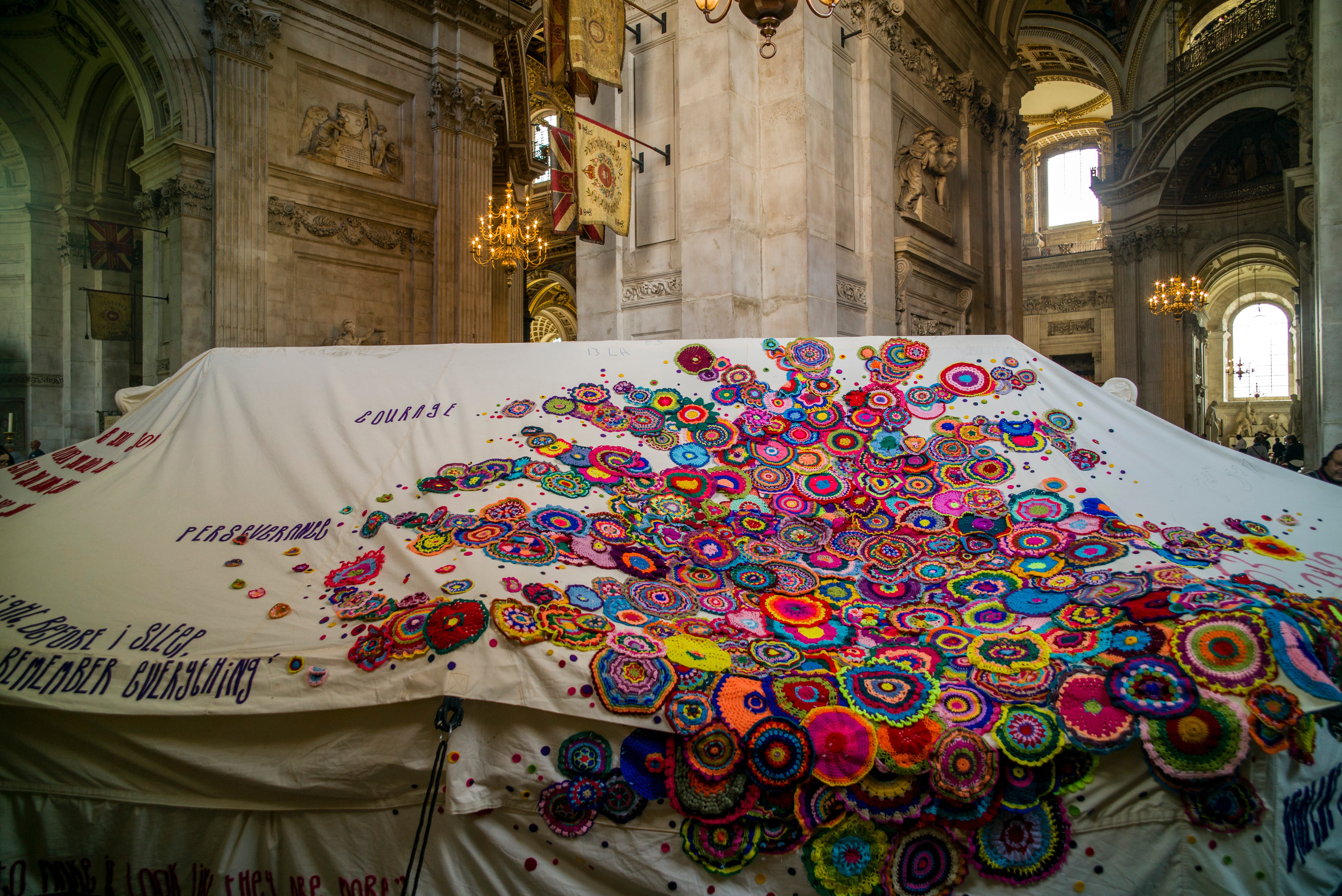
‘Am I My Brother’s Keeper?’ at Saint Paul’s Cathedral, London